Most carpet cleaners answer this question with a yes, and that is the reason so many households have paid for the same problem twice. The truthful answer has a condition attached. The condition is where the urine went after it landed.
We are Peter and Jackie, and we have been assessing pet contamination in Los Angeles homes since 2007. Expert carpet cleaning in Los Angeles, done right, can actually solve the problem for good. But telling people when cleaning will not solve their problem has cost us jobs. It has also meant we rarely get called back for the same odor.
The Honest Answer Depends on Depth
Carpet is a system rather than a single material. There is the face fiber you walk on, a backing that holds the fiber together, padding beneath that, and a subfloor beneath the padding. Understanding how these layers work together is part of any thorough guide to carpet cleaning that goes beyond surface treatment.
Urine enters at the top and travels down under gravity. How far it gets depends on volume, how long it sat, and how many times the same spot was used. A small accident wiped up promptly may never leave the fiber. A dog that used one corner for two years has almost certainly reached the pad.
Extraction cleans the carpet. It does not clean what is under the carpet. That single sentence resolves most of the confusion around this question, and it is why an honest assessment has to come before a quote.
How Urine Behaves Once It Dries
Fresh urine is mostly water with urea, creatinine, and ammonia, and it is mildly acidic when it lands. As it dries, bacteria break down the urea and release additional ammonia, which is why a spot smells stronger three days later than it did on the day it happened.
Over time, the residue oxidizes into urine salts, which are crystalline and not water-soluble. They sit in the fiber and backing and do very little until humidity rises, at which point they take on moisture and become active again.
That reactivation explains the pattern nearly every pet owner describes. The carpet was cleaned, the smell went away, and then on the first warm afternoon it came back as though nothing had been done. The crystals were still present, and the weather woke them up.
What Extraction Reaches and What It Misses
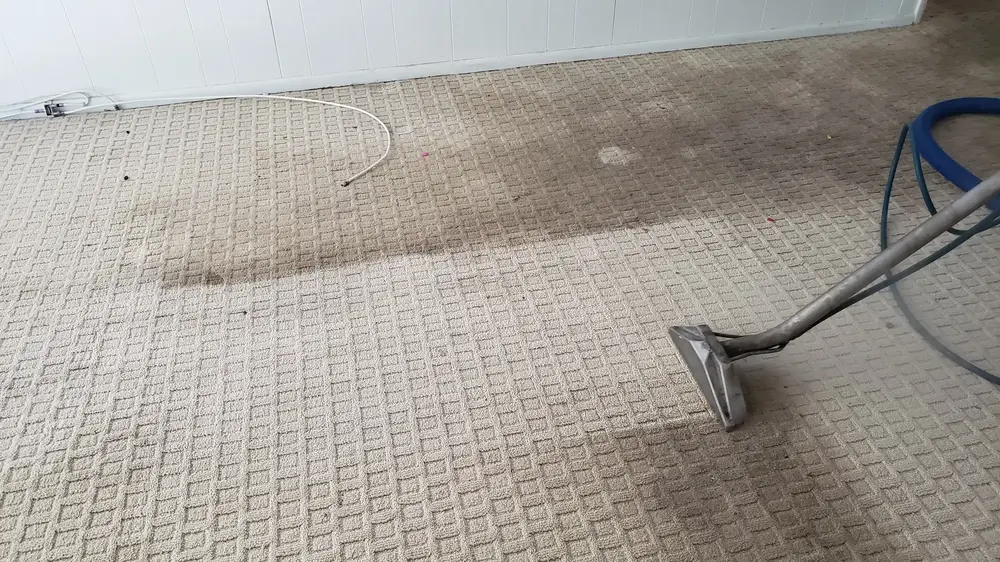
Truck-mounted hot water extraction delivers considerably more heat and suction than portable or rental equipment, which is what allows it to flush contamination out of the fiber and backing rather than merely wetting it. This equipment difference also affects how long a carpet cleaning job takes when a contaminated area needs full treatment.
For contamination confined to those layers, extraction combined with an appropriate enzymatic or oxidizing treatment removes the source rather than covering it. The odor does not return with humidity, because there is nothing left to reactivate.
| Contamination depth | What you notice | Realistic outcome |
|---|---|---|
| Fiber only | Odor near the spot, fades with airing | Extraction and treatment resolve it |
| Fiber and backing | Odor returns on warm or humid days | Usually resolvable, depends on assessment |
| Padding saturated | Odor persists, pad stiff or discolored | Pad replacement required |
| Subfloor involved | Odor strong even with carpet lifted | Pad replacement and subfloor sealing |
Padding is where the honest conversation happens. Foam padding is absorbent by design and holds urine like a sponge, sitting below the reach of anything applied from above. A cleaning in that situation buys roughly a week.
Odor that keeps coming back after previous cleanings? Call us at (818) 263-9314, and let us check the padding before you pay for another treatment. The answer takes minutes to find.
When Pad Replacement Is the Real Answer
Checking is straightforward. Lifting a corner of the carpet near the worst area shows the padding directly, and saturated padding gives itself away through discoloration, stiffness, or holding the smell when the carpet above it is dry.
Where the pad is contaminated, the work is different in kind. The carpet gets pulled back, the affected padding is removed and replaced, the subfloor is treated with an appropriate sealer if contamination reached it, and the carpet goes back down. That resolves the problem because it removes the source rather than treating around it.
We will not clean a carpet where pad replacement is the correct fix. A customer who spends money on extraction over a saturated pad has bought a delay, and telling someone that before they pay is the whole basis of how we prefer to work.
Signs the contamination has gone past the fiber:
- Odor that returns within days or weeks of a previous cleaning
- Smell that strengthens on warm or humid afternoons
- A pet that keeps returning to the same spot despite treatment
- Staining visible on the underside when a carpet corner is lifted
- Padding that feels stiff, crunchy, or damp to the touch
How We Assess Before Quoting
Peter maps the contamination zone with UV light first, because dried urine fluoresces and the affected area is nearly always larger than what is visible. Treating only the part you can see is a common reason homeowner attempts fail.
Depth gets checked physically by lifting a corner near the heaviest areas rather than guessing from the surface. That check produces the answer that determines everything else, and it happens before any number is discussed.
We hold IICRC certification in carpet cleaning and rug cleaning, and we use Green Seal certified products on every pet treatment we perform, which matters when an animal will be back on that floor within hours. Where extraction is the right answer, most carpets are dry in 4 to 6 hours. Where it is not, we say so.
Frequently Asked Questions
Will an enzyme cleaner from a pet store remove the smell?
For a fresh, surface-level accident treated promptly, often yes. Enzymatic products break down urine compounds effectively when they can reach them. They cannot reach contamination in the padding, and applying more product to the carpet surface does not change that.
Why does the smell come back after cleaning?
Either the padding holds the source, and surface cleaning never reached it, or crystals remained in the fiber and reactivated with humidity. Odor returning within a week of a cleaning usually points to padding.
Can I just replace the padding without replacing the carpet?
Frequently, yes. If the carpet fiber itself is in reasonable condition, replacing the affected padding and treating the subfloor resolves the odor while keeping the existing carpet. We assess whether the carpet is worth saving during the walkthrough.
Does the pet keep going back because of the smell?
Very likely. Animals detect residual urine at concentrations far below what people can smell, so a spot that seems clean to you can still read as a marked area to a dog or cat. Thorough removal rather than partial treatment is what breaks that cycle.
Should I clean if my pet is still having accidents?
The carpet can be cleaned, but recontamination will follow if the behavior continues. We usually recommend addressing the behavioral side alongside or before the cleaning, and we will assess pad saturation either way so you know what you are dealing with.
Get in touch at (818) 263-9314 or info@jpfloorcare.com, and we will assess the contamination depth in your home first, then tell you honestly whether cleaning is the right answer.
Related Topics: